
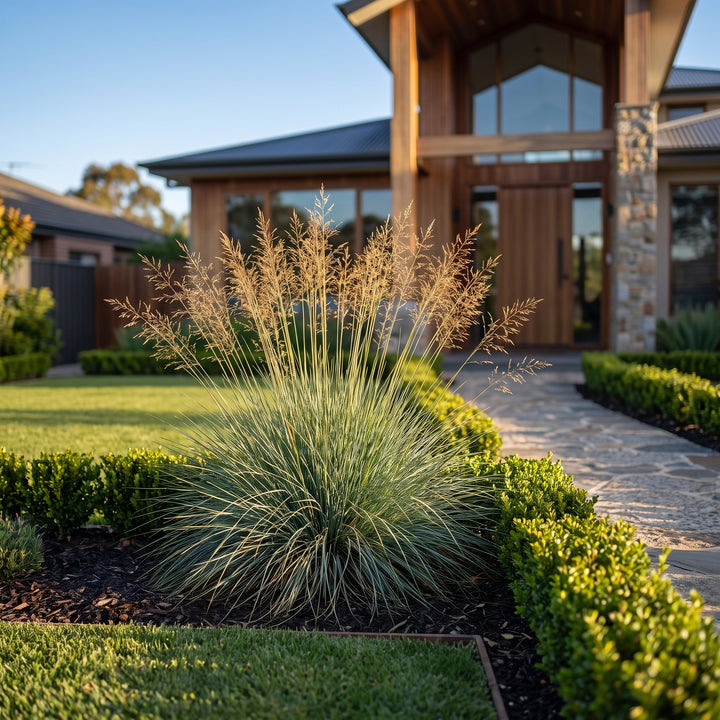
Common Tussock Grass
Poa labillardieri Eskdale PBR
From $17.95
Plant collection
Eighteen plants sit here; water decides which suit you. Five want the ground to stay moist: the four Carex sedges and sea rush. Six take the full swing, wet through winter then hard dry by February, which is what a swale or basin asks: both common rush listings, pale rush, Poa labillardieri and both Eskdale forms. The other seven are not wet-site plants: three more Poa tussocks, two blue fescue, swamp foxtail Nafray and Japanese blood grass. Fescue in wet ground is a dead plant waiting.
Carex appressa builds a heavy fibrous root mass, so it gets specified for batters, swale bases and dam edges. Four to six per square metre closes the cover. Its failure mode is dry ground: it survives, browns from the tips and goes ragged by February. The leaf margins cut skin, so keep it off path edges. Carex gaudichaudiana creeps slowly by rhizome into a low sward, has almost no drought tolerance, and belongs only where water collects. Juncus usitatus is a basin and swale plant; its catch is spread, seeding itself freely across damp ground. Sea rush takes brackish water, but its culms taper to a hard point, so keep it clear of narrow paths and seating. Pale rush ends bluntly and is safe to handle. All eight take part shade as well as sun; the weeping sedges want shelter from hot afternoon sun.
Poa labillardieri comes off damp flats and creek margins in south-eastern Australia. The Eskdale selections give a more even clump than seedling stock, which varies plant to plant. Poa poiformis KINGSDALE and the straight coast tussock hold dunes and clifftops, built for salt wind and loose sand. Poa sieberiana belongs inland on thin gravelly soil. Through a hot dry summer it goes semi-dormant and straw-coloured, then greens again with autumn rain; that is normal, and watering harder only rots it. Festuca glauca Beyond Blue holds its steel blue through Melbourne, Adelaide, Canberra and the tablelands, then rots out from the middle through a humid Brisbane or coastal New South Wales summer. Treat it as short lived even where it suits. Full sun for all of them, though Poa sieberiana also takes dry shade.
Tussock grasses accumulate dead leaf until the centre goes hollow. Cut Poa labillardieri low in late winter every second or third year, before new growth moves; the Eskdale forms take it annually. Kingsdale prefers a shear by half every second late winter; swamp foxtail Nafray takes the hard cut each late winter. Common rush and pale rush take the same low cut. Fescue does not; comb the dead blades out with a spring rake, since shearing leaves brown ends across the mound. Sedges split. Carex appressa takes a hard cut close to the base every two to four years; weeping selections such as Moon Falls are better combed by hand, because sedges can be slow to recover from hard cutting.
The wild green form of Japanese blood grass is blady grass, a running deep-rhizomed coloniser treated as a serious weed. Japanese Blood Grass in the trade is the slower red-leaved clumping selection; dig out at the root any shoot that reverts to plain green, and check state and council rules first. Straight Pennisetum alopecuroides throws viable seed into drains and bushland edges; Nafray was selected for very low seed set, not none.
All eighteen start at 140mm or smaller. A 140mm pot holds about a litre and a half of rootball and fifteen of the eighteen offer it; five reach 200mm, nearer four and a half litres. Plant small stock thickly; gaps are where weeds get in while clumps knit. Where a planting has to go longer between cut backs, the mat rush range covers it. On heavy soil, planting into clay deals with the ground first.
Choose from quality plants, compare options quickly, and use the filters to narrow the range by what matters most.
Poa labillardieri Eskdale PBR
From $17.95

Carex Moon Falls
From $17.95

Juncus pallidus
From $16.95

Juncus krausii
From $16.95

Juncus usitatus
From $16.95

Carex appressa
From $16.95

Poa labillardieri
From $16.95

Festuca glauca (Festuca ovina var. glauca)
From $16.95

Poa sieberiana
From $16.95

Poa poiformis var. poiformis
From $16.95

Poa poiformis KINGSDALE
From $16.95

Poa labillardieri Eskdale
From $16.95

Pennisetum alopecuroides NAFRAY®
From $16.95

Juncus usitatus [Basalt Provenance]
From $16.95

Imperata cylindrica
From $16.95

Festuca glauca Beyond Blue (Festuca ovina var. glauca)
From $16.95

Carex gaudichaudiana
From $21.95

Carex Feather Falls
From $19.95
Use this collection to compare plants by size, style, growing conditions, and the result you want to create. Whether you are upgrading a garden, styling a patio, adding privacy, or refreshing an indoor space, choosing from a focused collection makes it easier to find the right fit.
Before ordering, consider light exposure, watering needs, mature size, and where the plant will be positioned. These details help you choose plants that look good now and continue performing over time.
Shopping within a dedicated collection helps you focus on plants that suit a specific use, look, or garden goal. Use the filters and product details to compare options, then choose the plant that best matches your space.