
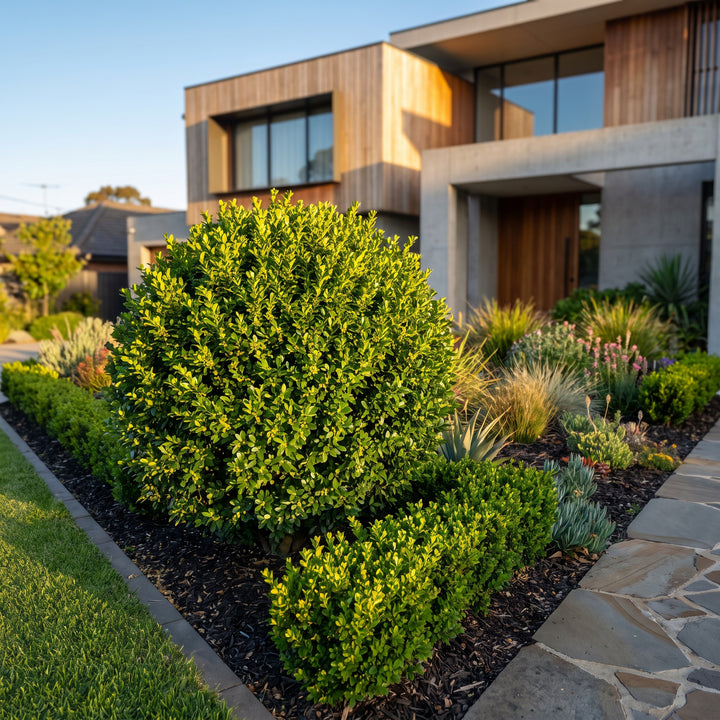
Japanese Box
Buxus microphylla microphylla
From $16.95
Plant collection
Buxus is the plant you reach for when a garden needs a clipped line that stays where you put it: a low border around a rose bed or vegetable patch, an edge along a path, a knot garden, or a matched pair of balls either side of a front door. It is slow and dense rather than fast, and that is the point. Clipped once or twice a year, a Box hedge holds its shape for decades. If you need two metres of screening by next summer, look elsewhere.
Two species do most of the work here. English Box, Buxus sempervirens, is the traditional European hedging box, deep green with a slightly larger leaf and a very tight habit in cool and temperate gardens. It resents long humid summers. Japanese Box, Buxus microphylla japonica, is the more forgiving choice for warm, coastal and subtropical gardens, with smaller, lighter leaves and better heat tolerance. Within the Japanese group, Faulkner is a selected form with rounder, glossier foliage that holds its green through winter rather than bronzing off, while Buxus microphylla microphylla is more compact and slower again, which suits very low borders.
Sizes cover both ends of the job. Hedging plants start as 66mm square tubes and 75mm pots from $16.95, the way to buy a long run if you can wait two or three seasons for it to knit together. The same plants are grown on into 200mm, 300mm and 500mm pots, and up to 200L for an established line from day one. Trained shapes arrive ready made: Japanese Box topiary balls from 250mm pots through to 100L, and English Box topiary cones from 300mm up. The price reflects years of clipping behind them.
Box wants free draining soil, full sun to light shade, and steady water through its first two summers while the roots take hold. Mulch well, but keep it clear of the stems. Clip after the spring flush and again in early autumn, leaving enough time for new growth to harden before the cold. What wrecks Box hedges here is box blight, a fungal disease that shows up as brown or bare patches inside an otherwise solid hedge, with dark streaks on the stems. It takes hold when foliage sits wet in still, humid air, so water at the base and never over the top of a hedge, leave real air space between plants, and clip only when the foliage is dry. Sterilise blades between hedges, and do not replant Box into a spot where a Box hedge has already died. Warm coastal gardens see the worst of it, and Japanese Box copes with those conditions better than English Box does. Box psyllid is the other one to watch: it cups and clusters the new spring tips into little cabbages, and clipping the affected growth off usually handles it.
For other formal options, see the full hedges range, or privacy screening if you need height as well as structure. Low maintenance plants suit beds where you would rather not be clipping, and advanced trees cover the larger stock for a garden you want looking finished sooner. Every order ships farm-direct with flat $99 delivery across QLD, NSW, VIC, SA, ACT and WA, a $399 minimum order, and the 30-Day Healthy Plant Guarantee.
New to these plants? Read our guide: Box hedging: spacing, clipping and blight.
Also in the range: Topiary and standards.
Choose from quality plants, compare options quickly, and use the filters to narrow the range by what matters most.
Buxus microphylla microphylla
From $16.95

Buxus microphylla
From $16.95

Buxus microphylla Faulkner
From $16.95

Buxus microphylla japonica
From $16.95

Buxus sempervirens
From $16.95

Buxus sempervirens Topiary Cones
From $149

Buxus sempervirens Topiary Balls
From $139

Buxus microphylla Topiary Cones
From $3,309

Buxus microphylla microphylla Topiary Balls
From $849

Buxus microphylla japonica Topiary Cones
From $319

Buxus microphylla japonica Topiary Balls
From $139

Buxus microphylla japonica Topiary
From $55.95
Use this collection to compare plants by size, style, growing conditions, and the result you want to create. Whether you are upgrading a garden, styling a patio, adding privacy, or refreshing an indoor space, choosing from a focused collection makes it easier to find the right fit.
Before ordering, consider light exposure, watering needs, mature size, and where the plant will be positioned. These details help you choose plants that look good now and continue performing over time.
Shopping within a dedicated collection helps you focus on plants that suit a specific use, look, or garden goal. Use the filters and product details to compare options, then choose the plant that best matches your space.