
Paperbark
Melaleuca hueglii (Callistemon)
From $16.95
Plant collection
Twenty one melaleucas, and fourteen of them carry Paperbark at the front of the title. The prefix is filing, not description. Melaleuca lateritia has no papery bark anywhere, and Little Red and Little Penta are bottlebrush selections that came across when Callistemon was folded into Melaleuca, so one plant turns up under both names. Melaleuca salicina is the third, listed twice: here as a paperbark in 300mm and 45L, and as Willow Bottlebrush in the bottlebrush range across seven grades from 140mm. Open both.
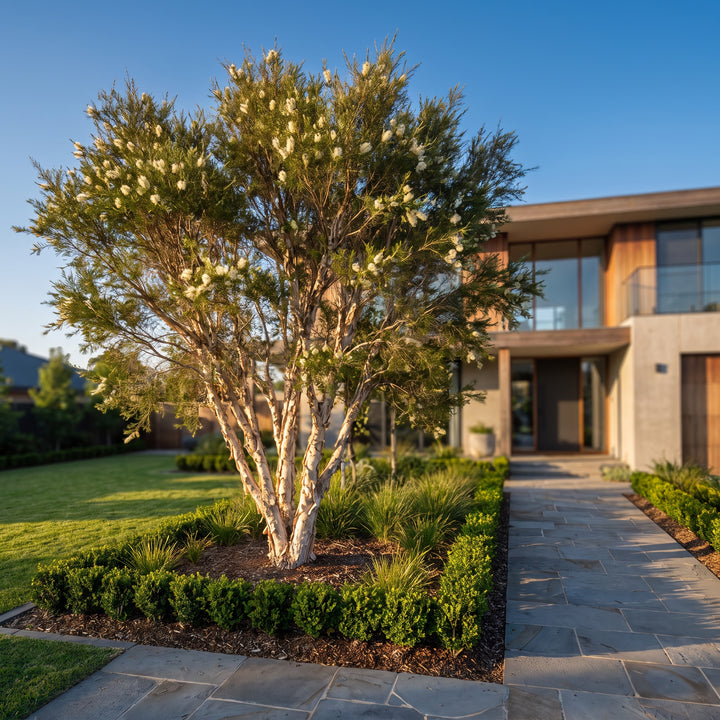
Broad Leaved Paperbark is the standard call for swales, detention basins and the low corner that floods after storms, and a safer bet across more of the country than the northern Melaleuca viridiflora. The costs: a wide surface root system damages slabs, driveways and stormwater lines, the flowers set off hay fever in some people, and it seeds freely, so keep it well away from remnant wetland outside its home range. Hard frost checks it, so keep it coastal, warm temperate or subtropical. In a frost pocket use Melaleuca parvistaminea, which handles cold on a swale or dam margin, or Melaleuca salicina, frost hardy once settled, with pink and bronze spring growth, though scale and sooty mould follow stress. Melaleuca linariifolia, snow in summer, takes the same heavy wet ground at garden scale, and it is the one to buy if the peeling white trunk brought you here. The two Melaleuca leucadendra lines are the tropical end: fast, genuinely large, frost tender while young, roots that find drains, so parks, acreage and wide verges. Melaleuca preissiana and Melaleuca rhaphiophylla are the Western Australian swamp trees, at home under water all winter, rhaphiophylla even in salty groundwater.
Moonah is the limestone coast survivor, dense on deep alkaline sand, low and twisted in wind, rounded in shelter. Scarlet Honey Myrtle is the exception to everything above. It wants sand, a mound or a slope, and air around the stems. In a wet airless summer on heavy soil it browns off inside a fortnight, root rot behind it. Showy honey myrtle self seeds beyond the garden in some southern districts, so check your council list. Melaleuca nodosa has sharp leaf tips, so keep it off paths, gates and play areas.
Snowstorm covers itself in white through summer at hedge height and never builds the papery trunk buyers keep expecting from the name. Melaleuca incana nana gives grey weeping foliage that breaks a run of dark green natives, and Narrow Nessie holds a screen line in a strip where the standard form sprawls. All want the same: shear the whole plant as soon as the brushes brown off, before the woody capsules set, every year. Leave a compact melaleuca to run for two seasons, then cut hard into bare old wood, and it is not reliably recovered from. Prune late and you remove the wood carrying the next flush.
Full sun for all; shade thins the crown and costs the density you paid for. Set compact forms 60 to 75 cm apart for a low informal hedge. On heavy clay, mound the bed and backfill with the soil you dug out, not potting mix, and read the clay planting guide first. Feed lightly with a native blend in spring on poor sand; established trees rarely need it. Myrtle rust attacks soft new growth across this family in humid coastal Queensland and New South Wales, so check the tips after each flush and water at the base. Expect bark and flower litter all year, so keep the trees off pool surrounds and gutters. Thirteen of the twenty one lines start in a pot under two litres, and nine are listed in a single size only. Broad leaved paperbark is the one that reaches 300L.
Choose from quality plants, compare options quickly, and use the filters to narrow the range by what matters most.
Melaleuca hueglii (Callistemon)
From $16.95

Melaleuca fulgens
From $16.95

Melaleuca salicina (Callistemon)
From $88.95

Melaleuca nesophila
From $16.95

Melaleuca Little Red PBR (Callistemon)
From $23.95

Melaleuca nesophila Narrow Nessie
From $59.95

Melaleuca Little Penta PBR (Callistemon)
From $16.95

Melaleuca linariifolia Snowstorm
From $16.95

Melaleuca viridiflora (Callistemon)
From $29.95

Melaleuca lateritia (Callistemon)
From $16.95

Melaleuca preissiana (Callistemon)
From $199

Melaleuca quinquenervia
From $29.95

Melaleuca rhaphiophylla (Callistemon)
From $29.95

Melaleuca parvistaminea (Callistemon)
From $19.95

Melaleuca nodosa (Callistemon)
From $16.95

Melaleuca Little Nessie (Callistemon)
From $17.95

Melaleuca linariifolia
From $18.95

Melaleuca leu. Fine Leaf (Callistemon)
From $29.95

Melaleuca leu. Broad Leaf (Callistemon)
From $29.95

Melaleuca lanceolata
From $16.95

Melaleuca incana nana (Callistemon)
From $16.95
Use this collection to compare plants by size, style, growing conditions, and the result you want to create. Whether you are upgrading a garden, styling a patio, adding privacy, or refreshing an indoor space, choosing from a focused collection makes it easier to find the right fit.
Before ordering, consider light exposure, watering needs, mature size, and where the plant will be positioned. These details help you choose plants that look good now and continue performing over time.
Shopping within a dedicated collection helps you focus on plants that suit a specific use, look, or garden goal. Use the filters and product details to compare options, then choose the plant that best matches your space.