
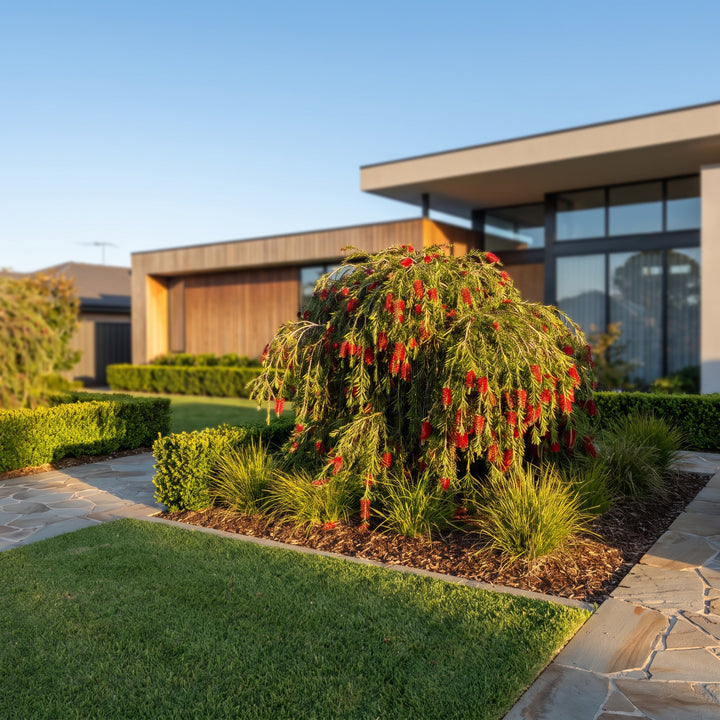
Weeping Bottlebrush
Callistemon viminalis prolific (Melaleuca viminalis)
From $16.95
Plant collection
Twenty seven bottlebrush listings, all Callistemon, all now filed under Melaleuca after a name change that altered labels and nothing else. Sort them by habit, not by flower. The dwarf mounds cannot screen anything. Twenty flower red. Of the seven that do not, willow bottlebrush is the cream one, Candelabra lemon, White Anzac white, pachyphyllus Green a yellow green, Candy Pink pink, Mauve Mist mauve, and Pink Champagne a paler haze.
Callistemon citrinus Endeavour is the one grown as a cut face: dense low down, and more willing under shears than the rest of the genus. Eureka is the near neighbour, and the difference is finish: a screen grown out with one trim a year. It pushes vertically, so a row set too wide stays a line of separate columns with daylight between them. Callistemon viminalis SLIM holds a column of foliage from the base up, which is what a bed a metre deep needs. It thins on any face jammed against a shaded wall. Candy Pink gives soft pink on a rounded shrub, but only in open sun.
Dawson River Weeper hangs hardest. Shear it flat and the regrowth returns stiff and upright, so the fall never comes back. Hannah Ray is the middle position, enough weep to read as one and enough tolerance of a trim to hold a boundary line. Captain Cook has no fall at all, a mounded dwarf for a low hedge under a window. All three sit in the weeping viminalis group, the cold tender end of this range. In an inland frost pocket around Orange young growth burns each winter, and a Captain Cook hedge never closes along the top.
Kings Park Special outgrows every other cultivar stocked here and arrives in a 200mm pot looking harmless. Under an eave, beneath powerlines or on a 900mm verge, the only remedy left is topping, and it never recovers. Willow Bottlebrush is the upright single trunked option, with white papery bark, and it handles cold better than the weepers. The straight weeping species runs surface roots that follow water into ageing clay drain lines and under slab edges. Keep it clear of both.
Most of this genus takes ground that stays wet for days after a storm, which is why bottlebrush belongs in swales and low corners on the basalt clay through Melbourne's west. Little John is the exception, and the trap, because it is the name most buyers already know. It wants sharp drainage. In unimproved clay it thins and dies out plant by plant. Mound the bed first. The pachyphyllus Green wants acid sandy heath soil, so the calcareous sand behind the Perth coast will yellow it. For cold districts take Callistemon pallidus Candelabra, which sits through frost and is the only one here that reshoots readily from older wood.
Cut the week the brushes brown off, taking the spent flower and a short length of wood behind it, before the seed capsules lock onto the stem. Keep the cut in leafy wood. Bare old stems reshoot slowly and unevenly, and the gap stays for years. Shear on the same autumn round as everything else on the block and you remove the wood carrying next spring's brushes. That one error accounts for most bottlebrushes that never flower. Feed a native blend after the cut, and watch soft new growth for myrtle rust through a humid Brisbane summer.
Sixteen of the twenty seven start at 140mm, roughly 1.5 litres, the grade for a hedge run. Five start at a 70mm tube. Nine listings carry a 45L and four reach 100L, the only route to immediate height. Dawson River Weeper, Endeavour and MacArthur each appear twice under separate listings with different grade runs, so open both. Melaleuca cousins sit under paperbark.
Choose from quality plants, compare options quickly, and use the filters to narrow the range by what matters most.
Callistemon viminalis prolific (Melaleuca viminalis)
From $16.95

Callistemon Dawson River Weeper (Melaleuca)
From $29.95

Callistemon Wee Johnnie PBR (Melaleuca)
From $16.95

Callistemon Eureka (Melaleuca)
From $16.95

Callistemon citrinus White Anzac (Melaleuca citrina)
From $16.95

Callistemon citrinus (Melaleuca citrina)
From $16.95

Callistemon 'LC01' PBR MacArthur TM (Melaleuca)
From $63.95

Callistemon Endeavour (Melaleuca)
From $29.95

Callistemon viminalis (Melaleuca viminalis)
From $16.95

Callistemon Mauve Mist (Melaleuca)
From $19.95

Callistemon salignus (Melaleuca salicina)
From $16.95

Callistemon viminalis MACARTHUR (Melaleuca viminalis)
From $18.95

Callistemon citrinus Endeavour (Melaleuca citrina)
From $16.95

Callistemon viminalis Dawson River Weeper (Melaleuca viminalis)
From $16.95

Callistemon viminalis Captain Cook (Melaleuca viminalis)
From $16.95

Callistemon viminalis SLIM (Melaleuca viminalis)
From $16.95

Callistemon Harkness (Melaleuca)
From $17.95

Callistemon Kings Park Special (Melaleuca)
From $16.95

Callistemon Candy Pink (Melaleuca)
From $16.95

Callistemon Little John (Melaleuca)
From $16.95

Callistemon Hannah Ray (Melaleuca)
From $16.95

Callistemon viminalis Pink Champagne (Melaleuca viminalis)
From $16.95

Callistemon viminalis Better John (Melaleuca viminalis)
From $16.95

Callistemon subulatus (Melaleuca subulata)
From $19.95

Callistemon Red Rocket (Melaleuca)
From $18.95

Callistemon pachyphyllus Green (Melaleuca)
From $16.95
Use this collection to compare plants by size, style, growing conditions, and the result you want to create. Whether you are upgrading a garden, styling a patio, adding privacy, or refreshing an indoor space, choosing from a focused collection makes it easier to find the right fit.
Before ordering, consider light exposure, watering needs, mature size, and where the plant will be positioned. These details help you choose plants that look good now and continue performing over time.
Shopping within a dedicated collection helps you focus on plants that suit a specific use, look, or garden goal. Use the filters and product details to compare options, then choose the plant that best matches your space.