

Yellow Gum
Eucalyptus leucoxylon subsp. megalocarpa Rosea
From $30.95
Plant collection
Gums are for blocks with room: open ground, a paddock corner, a front garden that can carry one canopy and little else. Plant one and you get honeyeaters from the first flowering, bark in sheets through summer, and a tree that lives on rainfall. They are not for courtyards, narrow side boundaries, or anything within reach of a pool, slab or septic line. If you want a clipped formal hedge, this is the wrong range.
There are 117 gums, corymbias and angophoras here, from the Kalgoorlie goldfields to the Tasmanian high country. The Western Australian dry country species want heat, sharp drainage and dry summers. Eucalyptus woodwardii holds its silver bloom under lemon yellow brushes on Perth medians and across dry South Australia. Put it in a Brisbane February and the bloom washes off and leaf spotting starts. Cold gardens run the other way. Argyle Apple comes off the Southern Tablelands and takes hard frost on thin gravel. Cider gum, from the Tasmanian high country, handles Orange and Canberra. Lemon Scented Gum is the warm end, a Queensland tree that shrugs off humidity but browns in hard frost while young.
The common mistake is a forest tree on a house block. River Red Gum is the standard example: floodplain country, dam surrounds, stock shade, and limb drop in still summer weather that rules out a house yard. Spotted Gum carries its crown high over a dappled bole, so it will not screen anything. For a suburban front garden, buy a selected small form like Euky Dwarf, single trunked with a crown low enough to sit under powerlines. Ten listings here are yellow gum forms, the group to check first on an ordinary block.
A forest gum will not clip into a formal line. Shear one and you get a knuckle of regrowth and an open wound. Clipping belongs in hedging plants. A young eucalypt covers eye level for a few years, then lifts its skirt and screens sky. Moort, Eucalyptus platypus, holds a dense crown almost to ground level and starts at 70mm tubes, which is what a shelter belt needs. A Western Australian mallet, it wants a dry summer: Perth, the wheatbelt, Adelaide, the drier inland. Never lift that skirt, because it has no lignotuber and will not shoot back. Silver gums are the exception, cut hard every year or two to keep the round juvenile leaf coming. Argyle Apple and Silver Leaved Mountain Gum go in the front row of a windbreak on that basis. Argyle Apple also seeds heavily and has naturalised beyond its range in parts of the south east, so keep it well back from remnant bush.
Sizes run from 70mm tubes to 800L bags, and 69 listings carry a 400mm pot, more than any other size. A 400mm holds roughly 35 litres of mix, a formed tree and a two person lift. Gums are where paying for that size gains you least. A 140mm plant, about a litre and a half, planted in autumn, or in spring where frost lifts a small ball, often draws level with a 400mm of the same species inside three summers. A young gum spends its first year sending roots down; a container tree arrives with a flat plate of them. Cut the circling roots. Stake low and loose, or not at all, and let the trunk move. Skip the compost and fertiliser, and keep lawn sprinklers off the collar. Rich soil and steady water grow soft wood that snaps in the first real blow.
For nectar at shrub scale, look at bottlebrush and paperbark in Australian natives. For one position rather than a species, start in feature trees.
Choose from quality plants, compare options quickly, and use the filters to narrow the range by what matters most.
Eucalyptus leucoxylon subsp. megalocarpa Rosea
From $30.95

Eucalyptus leucoxylon subsp. megalocarpa
From $16.95

Eucalyptus leucoxylon subsp. connata
From $16.95

Eucalyptus leucoxylon petiolaris
From $29.95

Eucalyptus leucoxylon Euky Dwarf ST Select
From $249

Eucalyptus lehmannii
From $149

Eucalyptus lansdowneana ssp albopurpurea Purple Patch
From $65.95
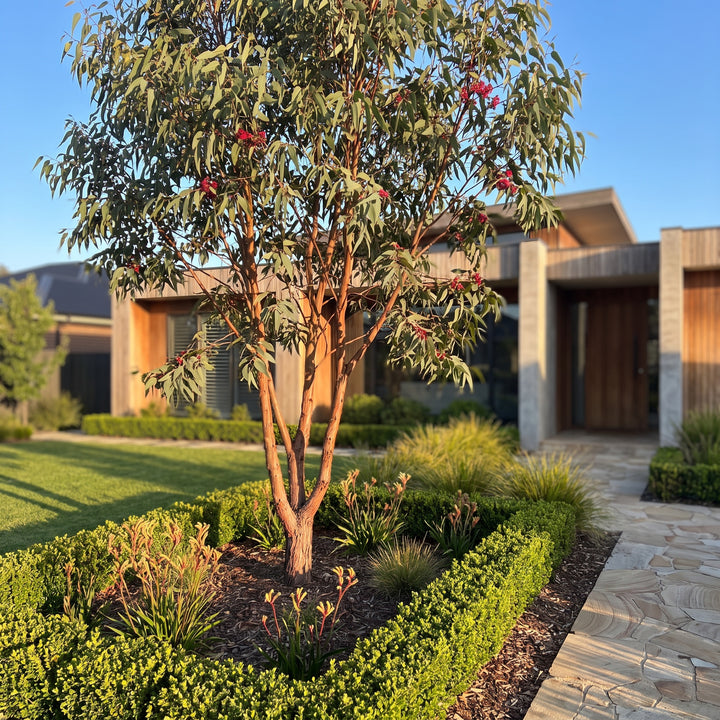
Eucalyptus lansdowneana ssp albopurpurea
From $30.95

Eucalyptus kruseana
From $29.95

Eucalyptus gregsoniana
From $129

Eucalyptus goniocalyx [Toolern]
From $279

Eucalyptus forresterae Little Star
From $279

Eucalyptus dolichorhyncha
From $16.95

Eucalyptus crenulata
From $16.95
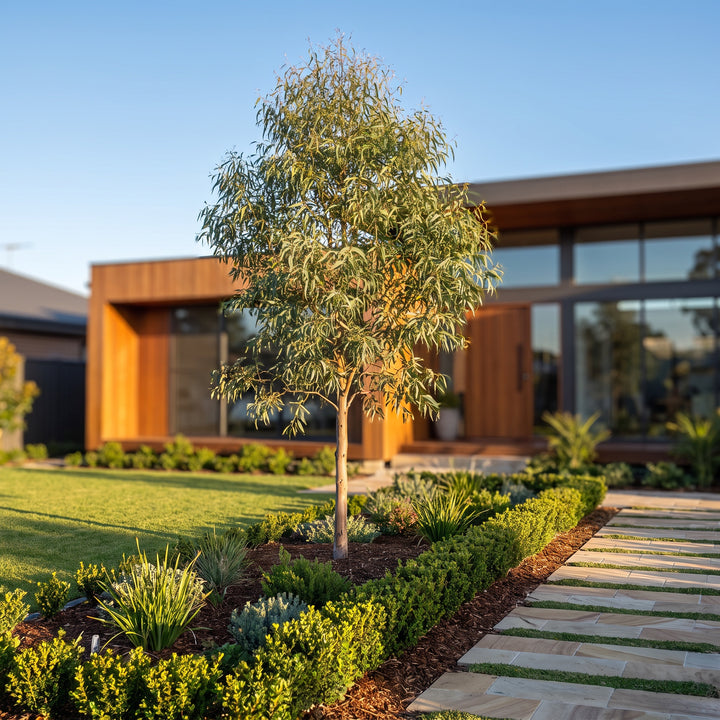
Eucalyptus crebra
From $32.95

Eucalyptus cosmophylla
From $16.95

Eucalyptus cinerea Silver Shadow
From $299
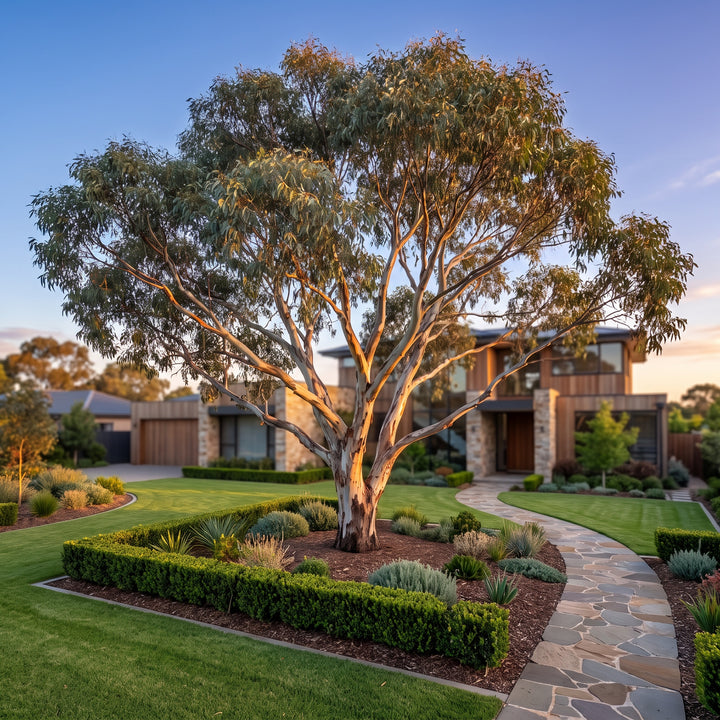
Eucalyptus camaldulensis [Wildwood]
From $279

Eucalyptus caesia Silver Princess
From $16.95

Eucalyptus caesia
From $16.95

Eucalyptus baueriana ssp. Werribee
From $279

Eucalyptus bancroftii
From $16.95

Corymbia maculata Lowanna (Eucalyptus maculata)
From $449

Corymbia ficifolia Wildfire Grafted (Eucalyptus ficifolia)
From $249

Corymbia ficifolia Red (Eucalyptus ficifolia)
From $289

Corymbia ficifolia Baby Orange Grafted (Eucalyptus ficifolia)
From $249

Corymbia ficifolia (Eucalyptus ficifolia)
From $16.95

Corymbia eximia Nana (Eucalyptus)
From $16.95

Corymbia eximia (Eucalyptus)
From $72.95

Corymbia citriodora Scentuous Grafted (Eucalyptus citriodora)
From $259

Corymbia calophylla (Eucalyptus)
From $189

Angophora hispida
From $55.95

Angophora floribunda
From $16.95
Use this collection to compare plants by size, style, growing conditions, and the result you want to create. Whether you are upgrading a garden, styling a patio, adding privacy, or refreshing an indoor space, choosing from a focused collection makes it easier to find the right fit.
Before ordering, consider light exposure, watering needs, mature size, and where the plant will be positioned. These details help you choose plants that look good now and continue performing over time.
Shopping within a dedicated collection helps you focus on plants that suit a specific use, look, or garden goal. Use the filters and product details to compare options, then choose the plant that best matches your space.