
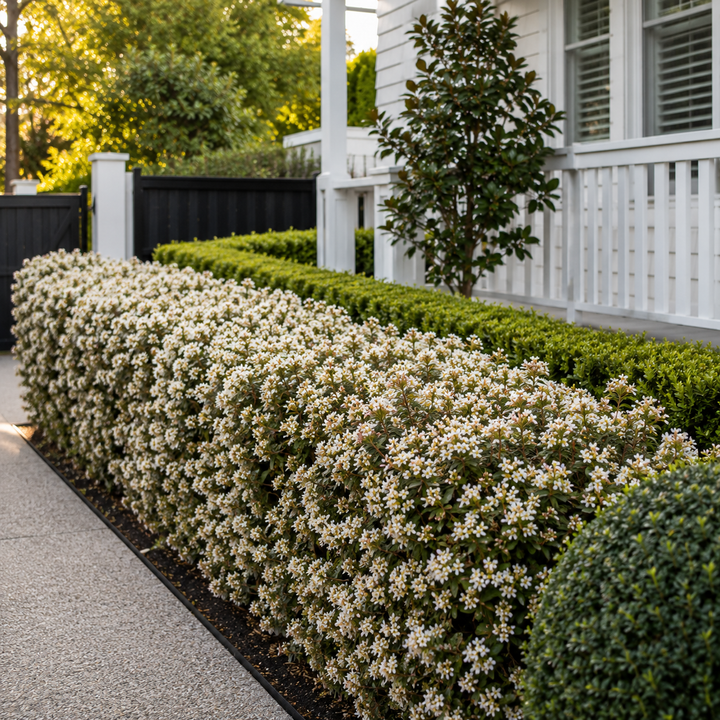
Indian Hawthorn
Rhaphiolepis indica Snow Maiden (Raphiolepis indica)
From $16.95
Plant collection
A hedge is a line you have agreed to keep cutting. That is the honest difference between this range and privacy screening, where a plant can stay shaggy and still do its job. Buy from here if you want flat faces and a defined edge: a low border around a rose bed, a green wall with corners you can see. Do not buy from here if what you want is a neighbour's upstairs window gone by next summer and no shears in your future. That is a screening job.
Camellias split into two camps. Japonicas want morning shade and cover from hot afternoon sun; their buds scorch in heat. Sasanquas handle more sun than japonicas do and are usually the answer for a flowering hedge along a fence in temperate Australia, though part shade still suits them. Put Camellia sasanqua Yuletide against a west-facing brick wall in Adelaide and you will spend three summers watching it bleach; with morning sun and afternoon cover it holds a clipped face for decades. Pruning divides the same way: sasanquas take a hard cut straight after flowering, japonicas only a light shape.
Full sun, sand, salt wind: that is westringia country. Westringia Wynyabbie Gem clips about as tight as box and runs on very little water once its roots are down. Shear it lightly from year one. Cut back into leafless old wood and it will not shoot from there. In warm humid gardens, Brisbane through the northern rivers, psyllid narrows the lilly pillies to the named resistant lines. Acmena smithii Allyn Magic holds a low dense line if you keep the water up to it. Syzygium australe Resilience was selected for the same resistance and is the taller boundary hedge, with no fixed ceiling, so settle the height before you plant. For a low run on a hot, dry site, Rhaphiolepis indica Snow Maiden takes about as much neglect as anything here.
A 200mm pot is the commonest starting size across this range, and 200mm and 300mm are the two most heavily stocked sizes overall. The step between them is bigger than the numbers suggest, because pot volume climbs with the cube: 200mm is roughly four and a half litres of root ball, 300mm about fifteen. That is what you buy when the species is slow, as camellia and box are. Viburnum and the lilly pillies move fast enough that smaller pots make sense on a long run.
Spacing decides density more than pot size does. Three plants to the metre for a low box or westringia border, two for a mid-height line, one to one and a half where the hedge is allowed real width. Tighter than that and you are paying for plants that will shade each other out from below.
Usually in the second year, and usually at one end. A run that starts in open sun and finishes under a jacaranda is really two hedges, and the shaded end never catches up. Split it into two species, or accept the step. Water is the other one. One dripper per plant looks even on paper, but the one beside the driveway sits in reflected heat and dries sooner. Walk the line in February and put a finger in the soil at both ends.
Shears through lilly pilly, photinia or camellia leave half a leaf behind on every cut. The torn edges brown off within a week and the face reads dirty until the next flush. Go over large-leaved hedges with secateurs instead. Box and westringia are small-leaved, and shears were built for them. Indian hawthorn is neither: broad leathery leaves take a light cut after flowering, not a shear.
For a low formal border, start with buxus and box hedging. For trained balls, cones and standards, see topiary and standards.
Choose from quality plants, compare options quickly, and use the filters to narrow the range by what matters most.
Rhaphiolepis indica Snow Maiden (Raphiolepis indica)
From $16.95

Camellia japonica Brushfields Yellow
From $16.95
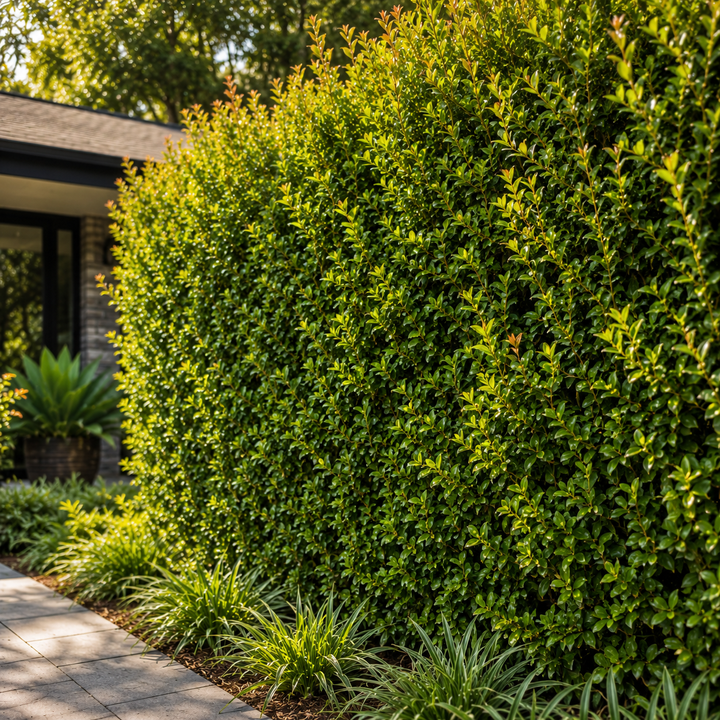
Acmena smithii Minor (Syzygium smithii)
From $16.95
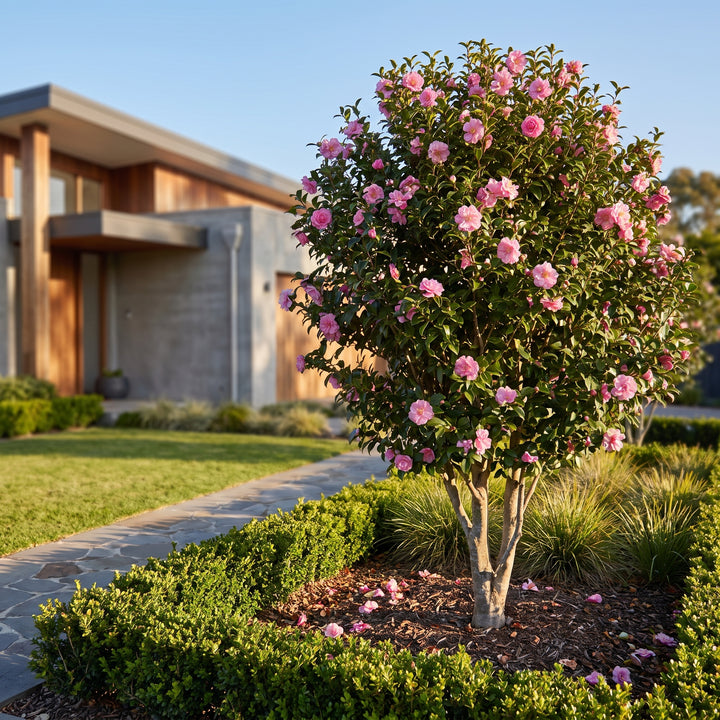
Camellia sasanqua
From $16.95

Waterhousea floribunda GREEN AVENUE (Syzygium floribundum)
From $39.95

Pittosporum tenuifolium Silver Sheen
From $16.95

Acmena smithii SUBLIME (Syzygium smithii)
From $30.95
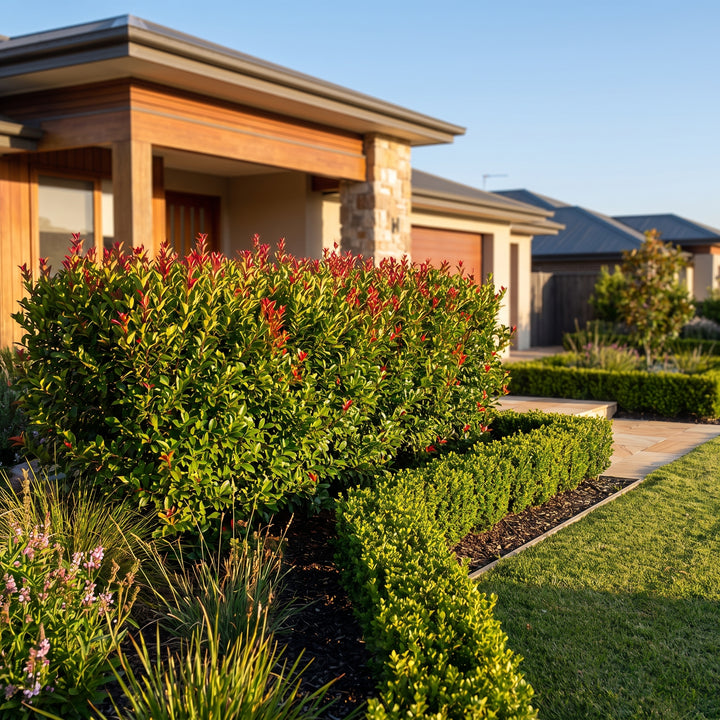
Acmena smithii FIRESCREEN (Syzygium smithii)
From $16.95
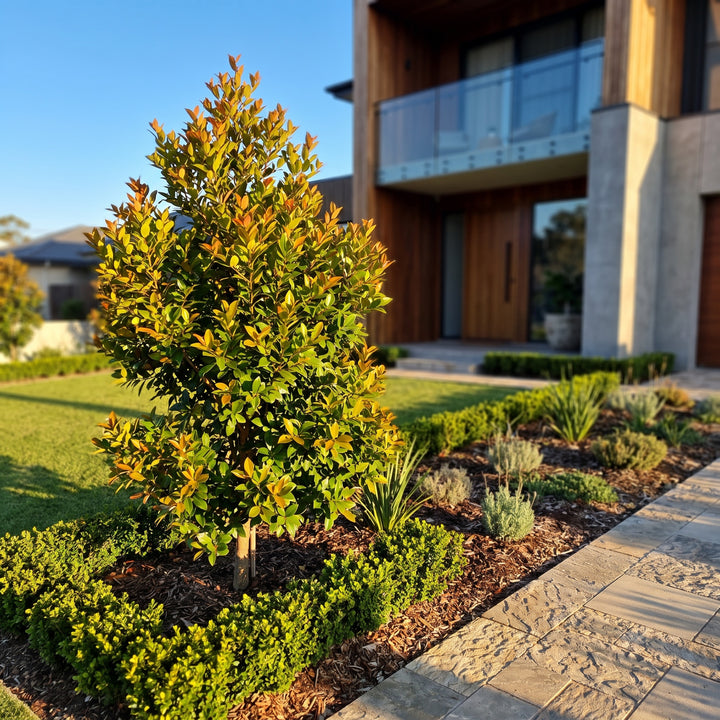
Acmena hemilampra (Syzygium hemilamprum)
From $16.95

Westringia hyb. NARINGA
From $16.95

Viburnum plicatum Mariesii
From $29.95

Thuja plicata Fastigiata
From $59.95

Teucrium fruticans
From $16.95

Syzygium floribunda (Acmena)
From $19.95

Syzygium australe Up and Away (Eugenia australis)
From $19.95

Syzygium australe Green Machine (Eugenia australis)
From $30.95

Rhaphiolepis indica Rapopink Oriental Pink (Raphiolepis indica)
From $17.95

Rhaphiolepis indica Pink Punch (Raphiolepis indica)
From $16.95

Rhaphiolepis indica Oriental Pearl (Raphiolepis indica)
From $18.95

Rhaphiolepis indica Minikins (Raphiolepis indica)
From $17.95

Rhaphiolepis Apple Blossom (Raphiolepis)
From $16.95

Pittosporum tobira Miss Muffet
From $17.95

Pittosporum tenuifolium SNOW LEOPARD
From $87.95

Michelia x. alba (Magnolia)
From $389

Michelia champaca (Magnolia champaca)
From $88.95

Laurus Flavour Master
From $18.95

Ficus microcarpa hillii Upright (Ficus hillii)
From $16.95

Ficus microcarpa hillii Standards (Ficus hillii)
From $109
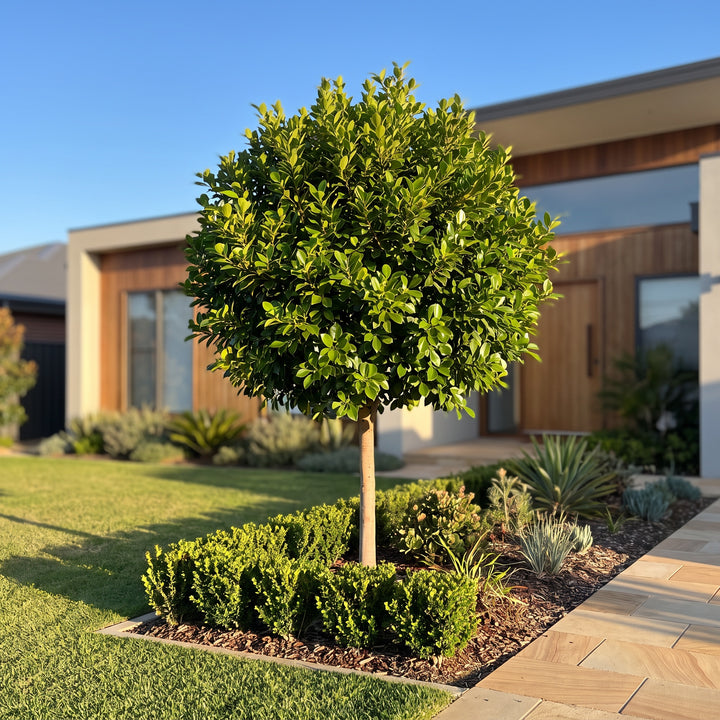
Ficus microcarpa Flash Standards (Ficus hillii)
From $50.95

From $16.95

Choisya ternata
From $16.95

Camellia sasanqua Wahroonga
From $16.95

Camellia sasanqua Pure Silk Standards
From $189

Camellia sasanqua Jennifer Susan Standards
From $189

Camellia sasanqua Fukuzutsumi
From $16.95

Camellia sasanqua Fuji-no-mine
From $16.95
Use this collection to compare plants by size, style, growing conditions, and the result you want to create. Whether you are upgrading a garden, styling a patio, adding privacy, or refreshing an indoor space, choosing from a focused collection makes it easier to find the right fit.
Before ordering, consider light exposure, watering needs, mature size, and where the plant will be positioned. These details help you choose plants that look good now and continue performing over time.
Shopping within a dedicated collection helps you focus on plants that suit a specific use, look, or garden goal. Use the filters and product details to compare options, then choose the plant that best matches your space.